
UAE hiring stages and how fast to reply at each
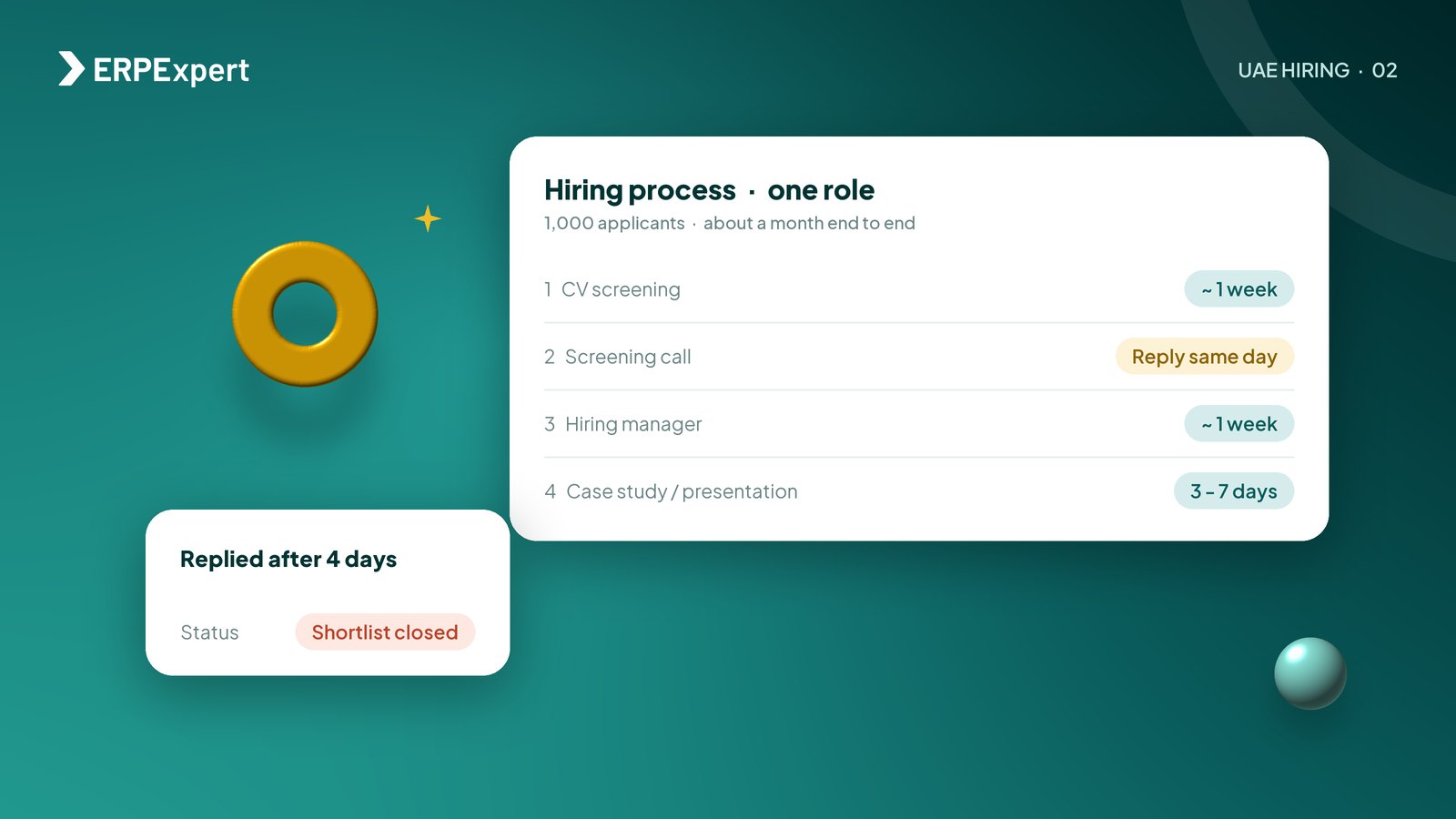
Four stages, and any one of them can take a full week. That is how a single vacancy moves through most of the UAE companies I have hired in, or watched hire from the inside.
Most applicants never factor that week in. HR messages a candidate on Sunday. He decides to reply on Wednesday, once he has had time to prepare. When he does reply, the stage has closed: three other candidates booked their slots on Monday.
Nobody rejected him. He fell out of the process because he was late.
The second of the ten points in the video this series is built on (in Arabic) is to reply on the same day. This article explains why, stage by stage.
Stage one: the CV screen
The company collects applications, and a junior HR officer usually sorts them. The test is simple: how close is this person to what the ad asked for? The screener compares the words on your CV with the words in the advert. They do not have the background to judge how deep your work went.
What helps here is what you wrote before applying: the industry the ad names, placed in the top third of your CV, and projects described with their numbers. That is the subject of writing a CV for the UAE.
The first practical question also surfaces at this stage. Are you living in the UAE right now? If you are applying from another country, your odds fall before anyone has phoned you, because the company wants someone who can attend an interview and start work without waiting on a visa.
Stage two: the screening call
Clear the screen and the same HR officer calls you for a short conversation, typically fifteen to thirty minutes. The questions are general. Tell me about yourself. What are you doing now? Why this role? What salary do you expect? When could you start?
This is the stage where timing decides the outcome. The person calling you has a list of ten or fifteen names and has been asked to pass three or four to the manager within the week. Answer the same day and you get a slot early in that week. Answer three or four days later and the shortlist may already be complete.
My own rule is to reply the same day, or the next day at the very worst. Two lines will do: “Thank you. I’m available on [day] or [day], any time in the afternoon.”
Four of those questions deserve an answer you have prepared before the phone rings:
- About you. One minute: your core skill, how many projects, which industries. Leave out the story that begins at university.
- Why this job. One sentence that connects something you know about the company to work you have already done.
- Expected salary. A figure or a range you settled on in advance, after asking around the market. Hesitating on this question tells the caller you have not thought about it.
- Start date. A specific date or a number of weeks, because your notice period with your current employer goes into the comparison between candidates.
Stage three: the main interview
Now you meet the manager you would report to, or someone senior from the same department. For technical roles this is the technical interview. In ERP hiring the questions tend to circle your past projects: which modules you configured, the hardest problem you hit, and how you dealt with a client who refused to work the way the system works.
Preparing for this stage starts with the company itself. Within the first five minutes the manager can tell whether you know what their business does. What to find out, and where, is set out in what to know before an ERP interview.
Stage four: the case study or presentation
Depending on seniority, the process may end with a practical task. A junior candidate might be asked to walk through the purchasing cycle on a trial instance of the system. A candidate for a leadership role might be asked to present an implementation plan for a hypothetical client, in fifteen slides or fewer.
The deadline is usually somewhere between three days and a week. The common mistake is to hand in something long that explains everything. The manager reads dozens of these submissions, and the one that stands out answers precisely the question asked, is quick to read, and states its assumptions clearly.
Most ERP case studies revolve around one of two cycles, so if your task concerns a business process, go over the procurement cycle or order to cash before you start.
How long the whole thing takes
At a week per stage, you are looking at roughly a month from application to offer. At large companies, or during holiday seasons, that can stretch to two months.
Two things follow. Keep applying after your first good interview, because a month is long and the job is not yours yet. And keep a simple log with the company name, the stage you have reached, and the date of the last message. Anyone applying to twenty jobs starts confusing them by the third week.
What your reply speed tells the hirer
Speed is about more than calendar slots. The person hiring reads something into it.
A candidate who answers within the hour is saying, without saying it, that they want this particular job. A candidate who answers after four days is saying they are waiting on another offer, or that they will handle work messages at the same pace once they are hired.
Out of a thousand applicants for one position, only a handful reach the final stage. A fast reply will not get you there on its own. A slow one can take you out before anyone has seen what you are capable of.
About the author
Ahmed Hassan Algammal
ERP implementation consultant. More than 60 deliveries across the UAE, Saudi Arabia and Egypt in manufacturing, contracting and distribution.
Book a call →