
Writing a CV for the UAE: projects first
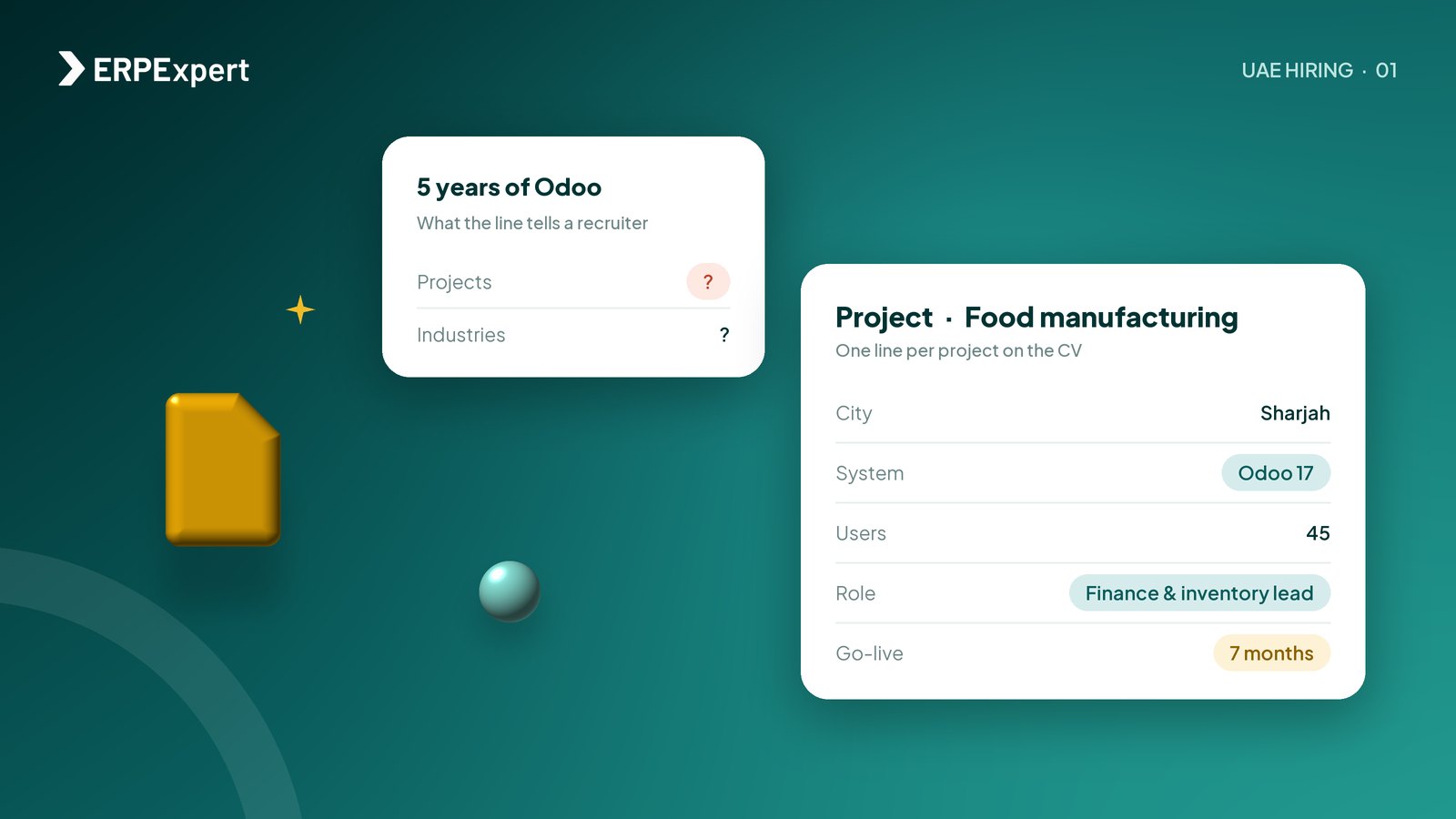
Three numbers. When a CV lands on my desk for an Odoo Functional Consultant role in Dubai, I look for them before I have read the candidate’s name: the number of projects, the industries they were in, and the role the person played on each.
Most applicants lead with a different number: years. “Five years of Odoo experience” tells me almost nothing. It fits someone who spent all five years on one project at one client, doing data entry under a consultant’s title. It fits someone with fourteen projects across three industries just as well.
This is one of the ten points in the video this series is built on (in Arabic), and it is the one you can fix in an hour.
Two readers, two different questions
The first reader is usually a junior HR officer. They have dozens of CVs for one vacancy, sometimes hundreds, and could not tell you how an inventory module differs from a manufacturing one. They do know what the hiring manager put in the job ad. If the ad asks for manufacturing projects, they scan your page for the word “manufacturing”, and if it is not in the top half of page one, they open the next file.
The second reader is the line manager. They are asking whether you have already met a problem like theirs. Say our next client is a food factory with sixty users. Has this candidate taken a project of that size live before?
Years of experience answer neither question. A list of projects answers both.
One line per project
Every project earns a single line carrying five pieces of information. Here is the shape, with an illustrative example rather than a real engagement:
Food factory, Sharjah. Odoo 17, 45 users. My role: finance and inventory lead. Seven months to go-live.
| Element | Why it is there |
|---|---|
| Industry and city | It is exactly what the first screener is searching for |
| System and version | Odoo 14 and Odoo 17 tell a manager specific things about the interface and the accounting |
| Size in users | An eight-user rollout and a 120-user rollout differ in how they are managed, and the configuration is the smaller part of that difference |
| Your precise role | “Member of the implementation team” says nothing. Name the modules you owned, and say whether you ran the workshops or sat in them |
| The outcome | Did it go live, and in how many months? An unfinished project still belongs on the page, with what you personally delivered |
If three or more of your projects sit in one industry, group them under a small heading such as “Three construction projects”. That heading on its own is enough to catch the first screener’s eye.
One skill per CV
People in this field tend to pick up several trades. Consulting, sales, some development, a bit of marketing. On my own experience I could apply for four quite different jobs.
A CV that shows all four at once reads as scattered. So the rule is simple: if the job is Odoo, the CV is about Odoo. Business Central or ERPNext gets one line at the foot of the page, or no line at all. Certificates follow the same logic. The official Odoo certification goes near the top; the web design course stays out of this version.
That means keeping several versions of your CV. One for consulting roles, one for sales, and one for development if you code. Each opens with the skill the job asks for and lists the projects that prove it.
If you have no projects yet
Build one, and describe it in exactly the same format.
Set up a fictional company on an Odoo trial instance. Run a complete purchasing cycle from purchase request through to the accounting entry, with twenty items and three suppliers. Write down what you did in numbers, and say plainly that it is a training project.
Nobody expects a beginner to have experience. The manager is looking for evidence that you understand how a project is put together. Your first ERP job walks through building that project step by step.
Your CV and your LinkedIn are one document
Everyone I have hired, and everyone I have watched hire, opened the candidate’s LinkedIn profile before the interview.
If the CV lists four employers and LinkedIn lists ten, the process is over before it started. The mismatch reads as something hidden, even when the real cause is that you forgot to update one of them.
Check the two side by side before every application: the same companies, the same dates, the same job titles. Five minutes costs less than an opportunity lost to a line nobody has touched in two years. If you worked for two companies over the same period, say why, whether it was “independent project” or “part-time”. It is the unexplained overlap that raises the question.
Six checks before you press send
- The industry named in the job ad appears in the top third of page one.
- Every project sits on one line with all five elements.
- There is one core skill, and it matches the job title.
- Employers and dates match your LinkedIn profile.
- Your current country of residence is stated, because the first interview question is very often whether you are in the UAE.
- The phone number listed works on WhatsApp, because replying the same day is part of how you are assessed.
A CV written this way will not guarantee you the job. What it does is move you into the five percent, out of a thousand applicants, who reach the second stage, which is where the real assessment begins. What happens at each of those stages, and how quickly you are expected to reply, is covered in UAE hiring stages and how fast to reply.
About the author
Ahmed Hassan Algammal
ERP implementation consultant. More than 60 deliveries across the UAE, Saudi Arabia and Egypt in manufacturing, contracting and distribution.
Book a call →