
Before an ERP interview: know the company and its rivals
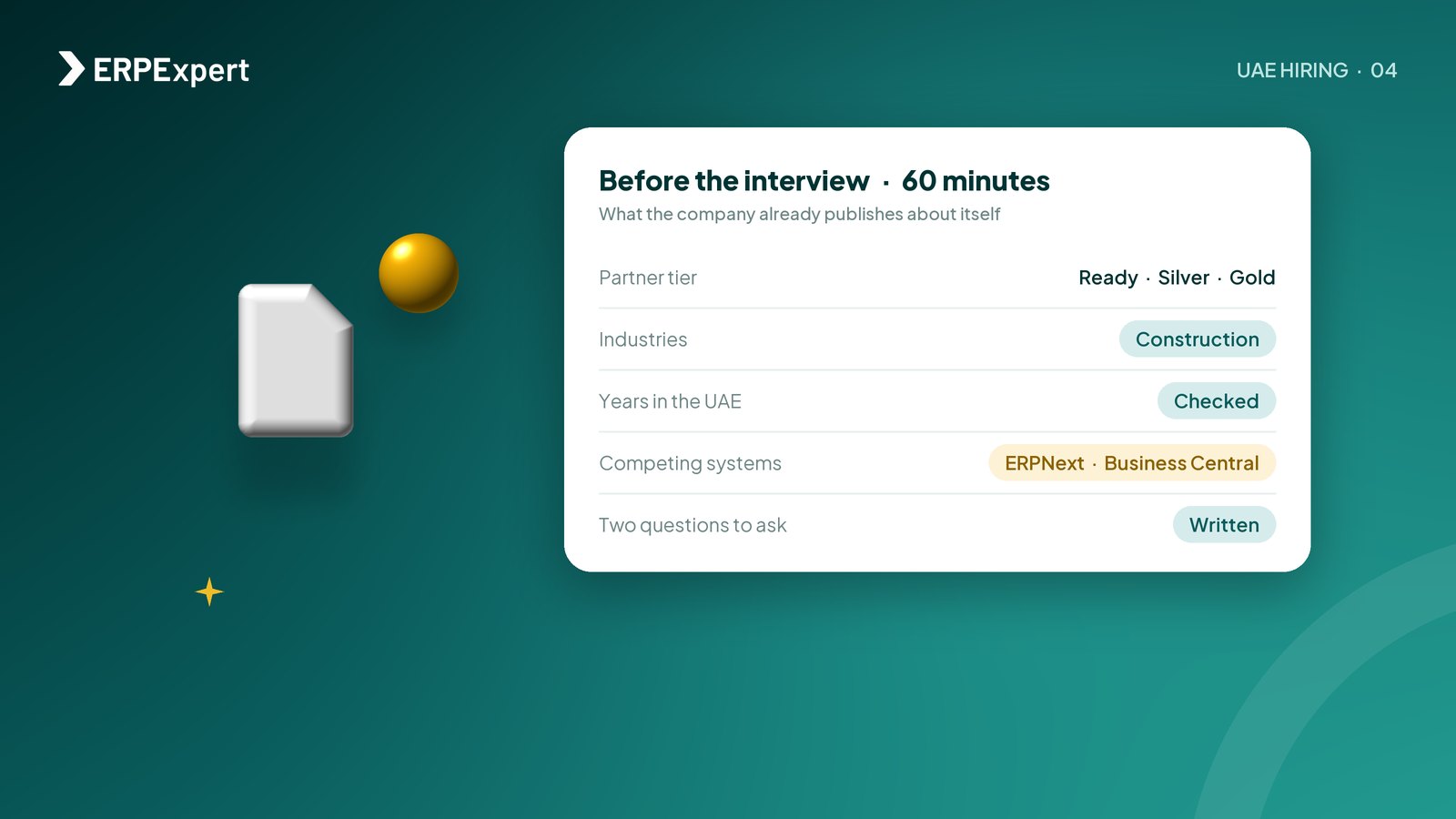
Five minutes. In every interview I have run, one question has settled my impression of the candidate inside that time: what do you know about our company?
I am not asking about profit, headcount or the terms of our contracts. I mean what the company publishes about itself, on its website and on its social accounts. A candidate who has not looked at any of that is telling me, without meaning to, that the same CV went to twenty companies and mine was one of them. I know of no faster way to end an interview.
This expands the eighth point in the video this series is built on (in Arabic), applied specifically to ERP roles.
Five things to know about the company
Take an interview at an Odoo partner in Dubai. Walk in with answers to these:
- Its partner level. Odoo ranks its partners in tiers, among them Ready, Silver and Gold, and publishes the ranking in the partner directory on its website. The tier tells you about the partner’s sales volume and how many certified consultants it has.
- The industries it serves. Some partners concentrate on construction, others on retail or manufacturing. The website and any published case studies will show you which.
- How long it has been in the UAE. A two-year-old partner and a ten-year-old partner work differently, and expect different things from a new hire.
- Whether it has offices outside the UAE. Branches in Saudi Arabia or Egypt mean shared projects and sometimes travel.
- Its latest news. A new client, a certification, a stand at GITEX. The last ten posts on its LinkedIn page are enough.
All of this is public, and it takes about an hour to read.
Two kinds of competitor
The harder question is who the company competes with, and the answer comes in two parts.
Other partners selling the same system. Dubai alone has dozens of Odoo partners. If you are going to work for one, you should be able to name three or four of the others and say how each one differs.
Other systems. Applying for an Odoo role means knowing that ERPNext is a direct competitor, even if you have never touched it, and that Odoo meets Microsoft Business Central in the mid-market. “I know Microsoft has a system, I just can’t remember what it’s called” counts against you. It says you have not looked at the market you are about to work in.
Alternatives are a different thing
An alternative is what the client does if it buys no ERP at all. It stays on Excel. It keeps an accounting package such as QuickBooks and bolts on separate tools for stock and sales. Or it hires a programmer and builds something in-house.
Vendors lose more deals to these options than to any named competitor, and understanding them is how you understand why a client hesitates. Two of them, the system already in place and the build-it-ourselves route, are covered in detail in the incumbent and “we’ll build it ourselves”.
How deep to go depends on the role
| Role | Depth expected |
|---|---|
| Sales and marketing | The deepest. Setting the company apart from competitors and alternatives is the job, so expect the manager to ask why a client would pick you over a named rival |
| Functional consultant | Know the competitors by name, and what distinguishes each system in the modules you will be working on. The systems comparison gives you that on one page |
| Developer | Know where the system sits in the market, and what that implies for the customisations you will be asked to build |
Consultants and developers are not expected to know the alternatives as thoroughly as sales staff, but it counts in their favour when they do. A consultant who knows what a rival system offers in inventory understands why a client is asking for a particular change.
Three ways to waste your preparation
Having done the reading, candidates still throw it away in how they answer. I see the same three errors again and again.
Reciting the About Us page. The manager wrote that page, or signed it off, and does not need to hear it read back. Pick one fact and tie it to your own experience instead: “I saw you work in construction, and I’ve taken two projects live in that sector.”
Generic praise. “A leading company with an excellent reputation” could describe any firm in the market, so it gives no sign that you read anything.
Running down competitors. You are expected to know them. Attacking them is another matter. A candidate who mocks another partner in a first interview makes the manager wonder how they will talk to clients.
An hour, allocated
If time is short, spend it like this:
- 15 minutes on the company website: services, industries, case studies.
- 10 minutes on LinkedIn: recent posts, headcount, and your interviewer’s profile if you know the name.
- 10 minutes in the vendor’s partner directory: tier and number of certified consultants.
- 15 minutes on competitors: two rival partners and two rival systems, one line on each.
- 10 minutes writing two questions to ask at the end, drawn from what you read.
Those two closing questions are what the interviewer remembers. Something like “I saw you delivered two construction projects this year. Is the team moving towards specialising in that sector?” shows that you did the reading and that you are already thinking about where you would fit. That is what puts you in the five percent who move on to the next round, as described in UAE hiring stages and how fast to reply.
About the author
Ahmed Hassan Algammal
ERP implementation consultant. More than 60 deliveries across the UAE, Saudi Arabia and Egypt in manufacturing, contracting and distribution.
Book a call →