
Research before a B2B sales call: what to collect
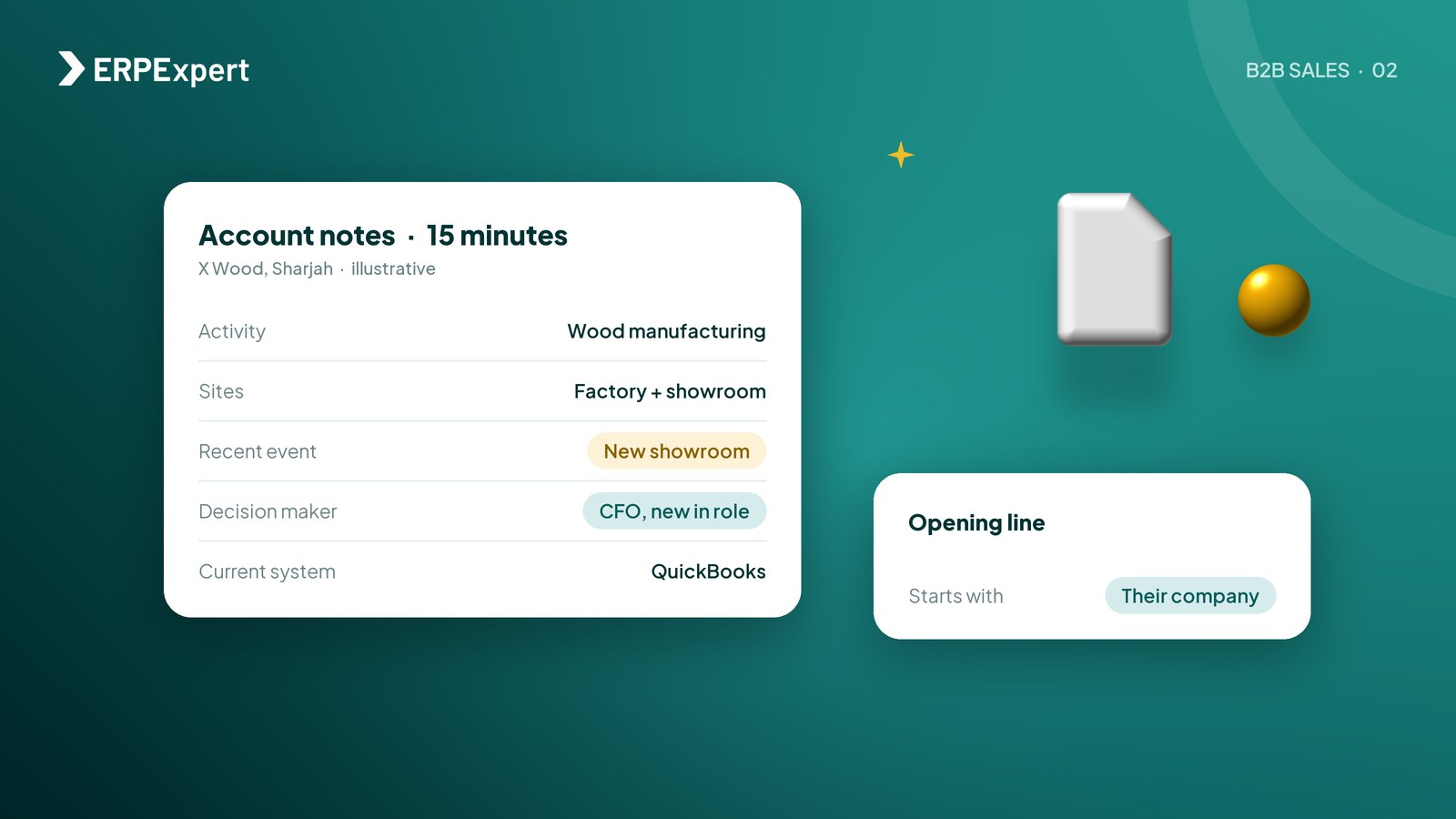
Fifteen minutes of research before each call. In my experience that is what separates the salesperson who books meetings from the one who collects “thanks, we’ll be in touch”.
The reason comes down to something I call credit. The person you are ringing does not know you and owes you nothing, not even a minute. Until you have earned a small amount of credit with them, everything you say lands as an advert. The quickest way to earn it is to talk about them before you talk about yourself.
In the training meeting behind this series (in Arabic), our new colleague asked whether he really needed to research every company before calling. The answer was yes. Every one.
Talking about yourself earns nothing
I made the point in the session with a direct example. Suppose I told my colleague: I’m Ahmed, I’ve been in this field for years, I hold these certificates. None of that would matter to him.
Now suppose I told him I had noticed three things about him since we met: he works hard, he asks a lot of questions, he learns fast. He would pay attention to whatever I said next, without ever deciding to.
A cold call runs on the same mechanism. In the first thirty seconds the owner has no interest in how long you have been in the industry. What catches him is hearing something about his company which shows you looked at it in particular, and that he is not just the next number on a list.
Five things to write down
Before any call, I ask the sales team to note five things about the company.
- What it does and how big it is. What it makes or sells, and a rough headcount from its LinkedIn page.
- Where it operates. One factory in Sharjah is a different prospect from three branches across three emirates, because running several sites is exactly the kind of problem the system solves.
- A recent event. A new showroom, a stand at GITEX, an announced expansion. The event is your reason for calling now rather than some other month.
- The decision-maker. The owner’s or finance director’s name, and when they took the job. A finance director appointed three months ago is often looking for a change to make their mark with.
- The current system, if you can see it. Job ads sometimes give it away. “QuickBooks experience required” tells you what the company runs on today.
Where to find it
Every source is open, and none of them needs a paid subscription:
- The company website for its business, branches and, sometimes, named clients.
- Its LinkedIn page for headcount, recent posts and new management hires.
- Its social media accounts for openings, exhibitions and events.
- Its job ads for the systems it uses and the departments that are growing.
Paid databases such as Apollo will give you names and phone numbers. What they cannot give you is a reason to call this particular company today. The recent event only turns up if you read.
Turning research into an opening line
Research is worth nothing unless it shows up in the first thing you say. Take an illustrative case: a timber company in Sharjah, which I will call X Wood, that opened a new showroom last month. The opening might run:
“I read about your new showroom opening, and it looks as though the business is growing quickly. I think there’s a chance for us to work together on a system that links the showroom to the factory and to the accounts. I was also wondering where you are with e-invoicing.”
It starts with his company. It then ties the expansion to a problem anyone who has opened a second site will recognise: stock in two places, sales in two places, and the accounts in a third. The offer comes only after that.
If the event is a new appointment, the line changes shape:
“Congratulations on the new role. A finance director’s first few months usually involve reviewing the systems they’ve inherited, and I’d be interested to hear how you see things at the moment.”
It congratulates, names something every new finance head will recognise, and asks a question. It offers nothing.
Written outreach needs the same work
A generic email or WhatsApp message gets deleted at the first line. One that opens with “I saw you at GITEX” or “Congratulations on the new role” gets read to the end.
AI tools now make it easy to write a tailored message for every company, provided you give them the material. The tool can draft the sentence. The event that makes the message personal is something you have to find yourself.
What to leave out
Research turns up more than the call needs, and some of it hurts you if used. We keep three rules.
One fact is enough for the opening. Reel off five facts about the company in the first minute and you sound as if you are reading from a sheet.
The company, never the person. The showroom, the expansion and the new appointment are public news the company chose to announce. The decision-maker’s personal accounts and life outside work have no place in the call.
Do not presume the problem. “I read that you’re having inventory problems” puts the prospect on the defensive. Ask instead: how do you manage stock between the showroom and the factory at the moment?
Research gives you a reason to call and a subject for your first question. If the call goes well, the prospect tells you the rest.
Is there really time for this?
The objection I always hear is that fifteen minutes per call means fewer calls. That is true, and it is the point.
The arithmetic is simple. With a monthly list of fifteen companies, researching all of them takes about four hours a month. That is less than you lose in a single day of dialling sixty numbers you know nothing about. Why the list is fifteen companies rather than a hundred, and how to choose them, is the subject of the B2B target account list.
About the author
Ahmed Hassan Algammal
ERP implementation consultant. More than 60 deliveries across the UAE, Saudi Arabia and Egypt in manufacturing, contracting and distribution.
Book a call →