
The B2B cold call: what the first call is for
One question opens every training session I run for new salespeople, before we touch a single technique: what has to come out of the first call to a company that has never heard of us?
Most answers are about selling: the prospect should learn what we offer, or ask for a quote. The answer I work to is far narrower. The first call succeeds if it ends in a second call, an online meeting, or the owner saying “come in and let’s talk”. Every other outcome misses, however encouraging it sounded at the time.
What follows unpacks the first part of the training meeting behind this series (in Arabic), a real session we filmed with a new colleague on the sales team.
Why the goal is that narrow
Nobody closes an ERP deal on a phone call. In my experience a deal runs three to four months from first contact to signature, and more than one person inside the buyer is involved in it. A rep who tries to sell in the first minute is asking for a decision the other person cannot make alone.
A narrow goal also makes performance easy to measure. Judge a rep on calls made and you get sixty calls a day with no meetings booked. Judge them on meetings booked and they learn very quickly which calls deserve their time.
Even being passed to a secretary can count as a win, on one condition. The handover has to be for booking time with the decision-maker, and not a polite way of getting rid of you.
The question that opens the door
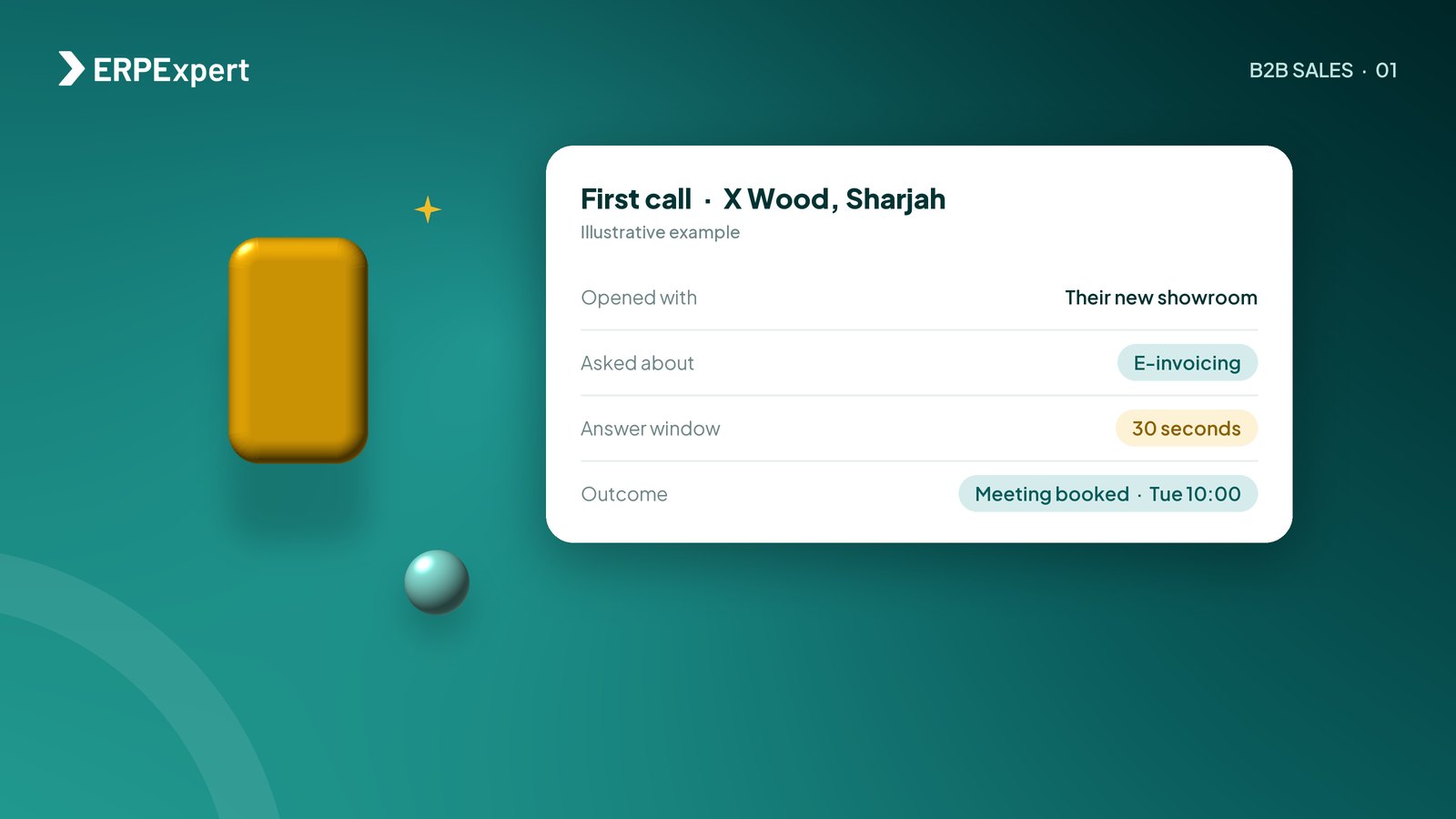
During our role play, the prospect asked the rep: do you do e-invoicing?
That question is the most important moment in the call. A prospect who asks has opened a little space and is showing the first sign of interest. A one-word answer throws that space away. Say yes and you may be transferred to the accountant. Say no and the call is over.
You have somewhere between thirty seconds and a minute. The answer I teach goes roughly like this:
“Yes, we handle e-invoicing, though it’s one part of a bigger piece of work. We start from the problems in your business. We visit, look at where operations get stuck, and then work out how the system helps management fix them. E-invoicing sits inside that, because your accounts have to connect to it.”
It acknowledges the question, then moves from a single service to the prospect’s own problems. In the UAE, e-invoicing is on every finance manager’s mind at the moment, which makes it a natural way into a wider conversation.
Why “the problems in your business” works
Tell someone not to think of an elephant and an elephant is the first thing they picture. The phrase works on the same principle. When an owner hears “the problems in your business”, three or four of them come to mind before you have named any. He already wants them solved, and he has quite likely wondered whether software could do it.
The phrase also changes who you are on the line. Before it, you were another marketing call of the sort telecoms companies make. After it, you are someone who may see a familiar problem differently, and who might have a way to save him money. People stay on the phone longer with a consultant than with a rep.
How a conversation becomes an argument
In the second round I played a sceptical prospect. The rep introduced himself as an ERP consultant and asked about e-invoicing. I asked what a consultant had to do with invoices. He said e-invoicing was part of the system. I said it was part of accounting, and I did not need an entire system to issue an invoice.
He was essentially right. He kept insisting, though, and the call turned into two people disputing a point. It ended the only way an argument with someone who owes you nothing can end: “thanks”, and the line goes dead.
The mistake was one of timing. Correcting a prospect requires some credit with him first, and the rep had not yet earned any. How to earn it before you dial is the subject of research before a B2B sales call.
Three lines that end calls early
Reviewing the team’s calls, three phrases keep turning up in the ones that were over inside a minute:
- “Have you got two minutes?” It hands the other person a ready-made exit, and most people take it.
- “We’re a leading company in…” The owner hears that line from everyone who rings him, so it sets you apart from no one.
- Reading out the service list. Twenty services in sixty seconds are forgotten before you reach the end.
The fix is the same in all three cases. Say one sentence about his company, then ask a question about his work.
The call is a conversation
The discovery sequence is well known: understand the prospect’s current situation, then the problem, then how much it is costing them, then the solution. The discovery station covers it in detail for systems deals.
Run it as a numbered checklist, though, and you sound mechanical, which the prospect picks up by your second sentence. It works better to talk the way you would with a friend you hoped to bring into a venture. You would not ask him outright whether he fancied a partnership. You would tell him what you have, describe the opportunity you can see, and leave him room to picture the result himself.
How to score the call
At the end of every first call, one question settles it: is there a specific appointment in the calendar?
If there is, the call worked, even if it was short and clumsy. If there is not, it failed, however friendly it felt. The test is harsh on purpose. It stops a salesperson fooling themselves with pleasant calls that lead nowhere.
What comes after that first appointment is covered in the rest of this series, from choosing which companies to call to the long cycle that ends in a signature.
About the author
Ahmed Hassan Algammal
ERP implementation consultant. More than 60 deliveries across the UAE, Saudi Arabia and Egypt in manufacturing, contracting and distribution.
Book a call →