
Ten chosen accounts or fifty calls? The B2B target list
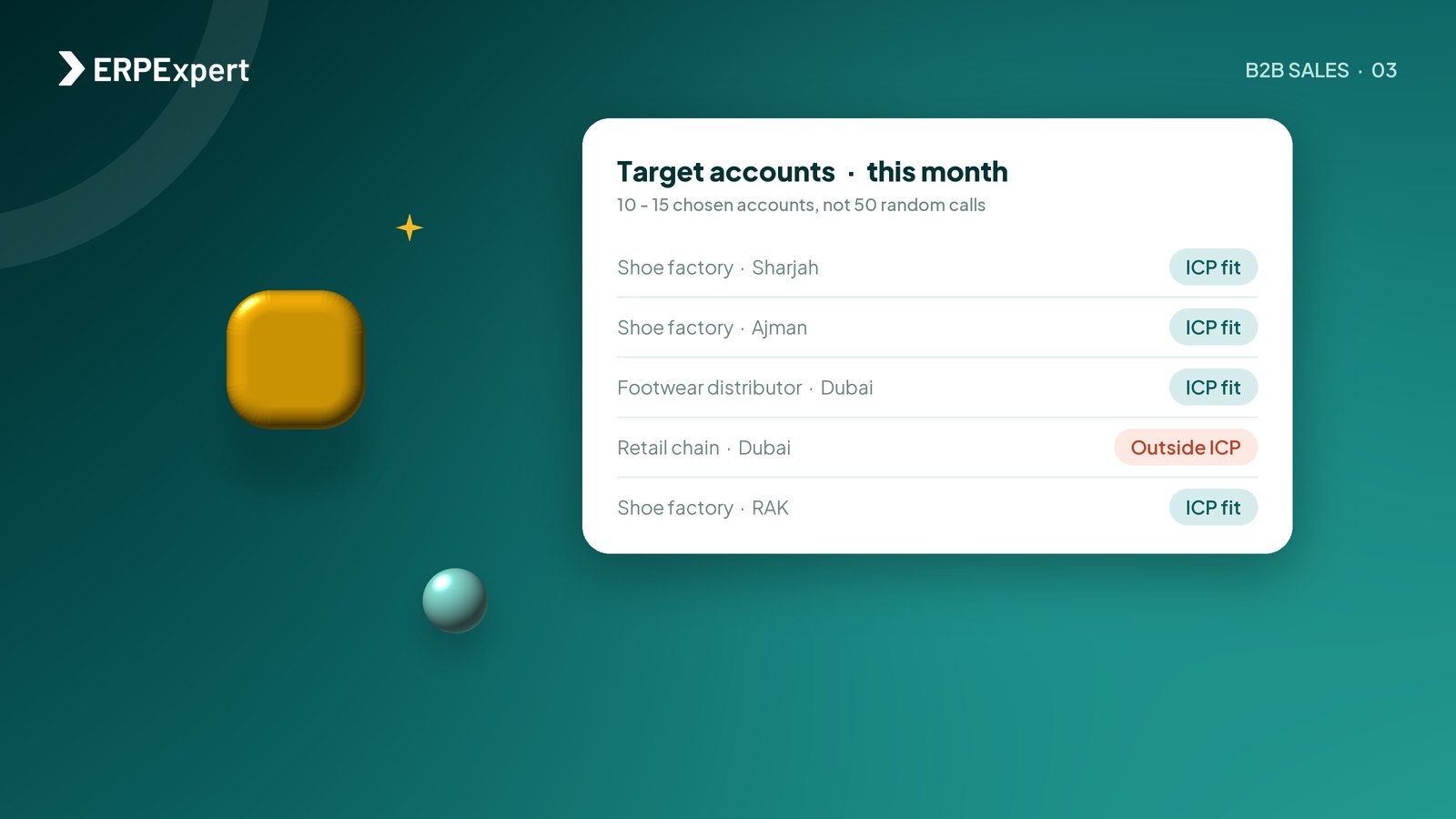
Ten to fifteen companies a month, each picked by name and researched. In my experience that list brings in more deals than fifty calls a day to numbers the caller knows nothing about.
It runs against what most salespeople are taught in their first job, which is that more calls produce more results. That holds when you sell something cheap to a wide audience. It does not hold when you sell a system that will live inside a company for years and whose rollout takes months of work.
This article covers the part of the training meeting behind this series (in Arabic) that comes before any call is made: deciding who to call at all.
A great call with the wrong client
You can have an excellent call with a factory, book the meeting and reach a signature, only to discover during the project that the factory was never a fit. Its requirements fall outside what the system covers, or its management has no time for the project, or its budget cannot pay for what the work needs.
A client like that costs you more in support and disputes than it ever paid you.
This is where outbound calling parts company with social media advertising. With an ad, you put a message in front of a broad audience and ring whoever leaves their details, so the client has done the selecting. With outbound, the selecting is your job, which is why it has to happen before you pick up the phone.
The ideal customer profile
Before we contact any company, we write down our ideal customer profile, or ICP: a description of the company we want, built from four elements.
- Industry. One sector, perhaps two, whose operations we know well.
- Size. A range of employees or users, since a ten-user project is a different animal from a two-hundred-user one.
- Current setup. A company running on Excel and a standalone accounting package is a different prospect from one that already has a system it wants to replace.
- Trigger event. An expansion, a new branch, or a regulatory mandate such as e-invoicing. The trigger is what makes a company buy now, and it is the subject of why ERP actually gets bought.
Signs a company is outside your profile
A written profile also lets you drop companies before they eat your time. Any one of these four signs is enough for us to take a company off the list:
- The decision-maker cannot set aside time for a project. A systems project needs hours of management attention every week, and someone who cannot give them will not take a system live.
- The core requirements sit outside what the system covers without heavy development.
- The stated budget is far below what the project realistically costs, and there is no willingness to discuss it.
- There is no trigger event. A company content with how things are will not move, however good the offer.
Ruling a company out in month one is far cheaper than finding out in month five of the project.
One sector, one case study
Suppose, for illustration, that we have chosen shoe factories. The next step is to approach them with something of value before we ask for anything: a way of calculating inner and outer cartons for packing, say, or a method for cutting waste at a particular stage of production. Something the factory can use for free, whether or not it ever signs with us.
When we call afterwards, we call as the people who gave them something useful. When we close the first project in the sector, it becomes a case study for the next factory. By the fifth factory, the prospect is hearing about four others just like it, and that is more persuasive than any slide deck.
Enter by more than one door
A short list lets you try the same company several times, through several routes. If the call to the owner goes nowhere, you still have:
- Another senior manager, such as the finance director or the operations manager.
- Reception or the secretary’s desk. Ask for whoever is closest to the subject, rather than for the decision-maker directly.
- The IT department, often the first to feel the pain of disconnected systems.
- LinkedIn, where the company’s staff are listed. A considered message to one of them can open a door the phone call closed.
It mirrors the idea behind the decision map. Several people influence a systems purchase, and whoever knows them can come in through the most suitable one.
What the month looks like
For a single salesperson, a working list runs like this:
| Step | What it involves |
|---|---|
| Add accounts | Ten to fifteen new companies each month, all matching the ICP |
| Research | Every company researched before first contact, as set out in research before a B2B sales call |
| Attempts | Three to five attempts per company, across different channels, before moving on |
| Record | A log for each company: who you spoke to, what they said, and what happens next |
Over time you come to know things about these companies that some of their own staff do not: who makes the decision, what system they run, and when its contract ends.
What a short list will not do
A short list produces nothing in the first month. Systems deals close after three or four months, so month one looks slow next to a colleague who dials sixty times a day and logs plenty of activity.
The difference shows up in month four, when the companies you worked on in month one start reaching signature while you keep adding new ones. How that compounds, and why you should not write off a company that turned you down today, is covered in the B2B deal cycle and your network.
About the author
Ahmed Hassan Algammal
ERP implementation consultant. More than 60 deliveries across the UAE, Saudi Arabia and Egypt in manufacturing, contracting and distribution.
Book a call →