
The three-to-four-month B2B deal cycle and your network
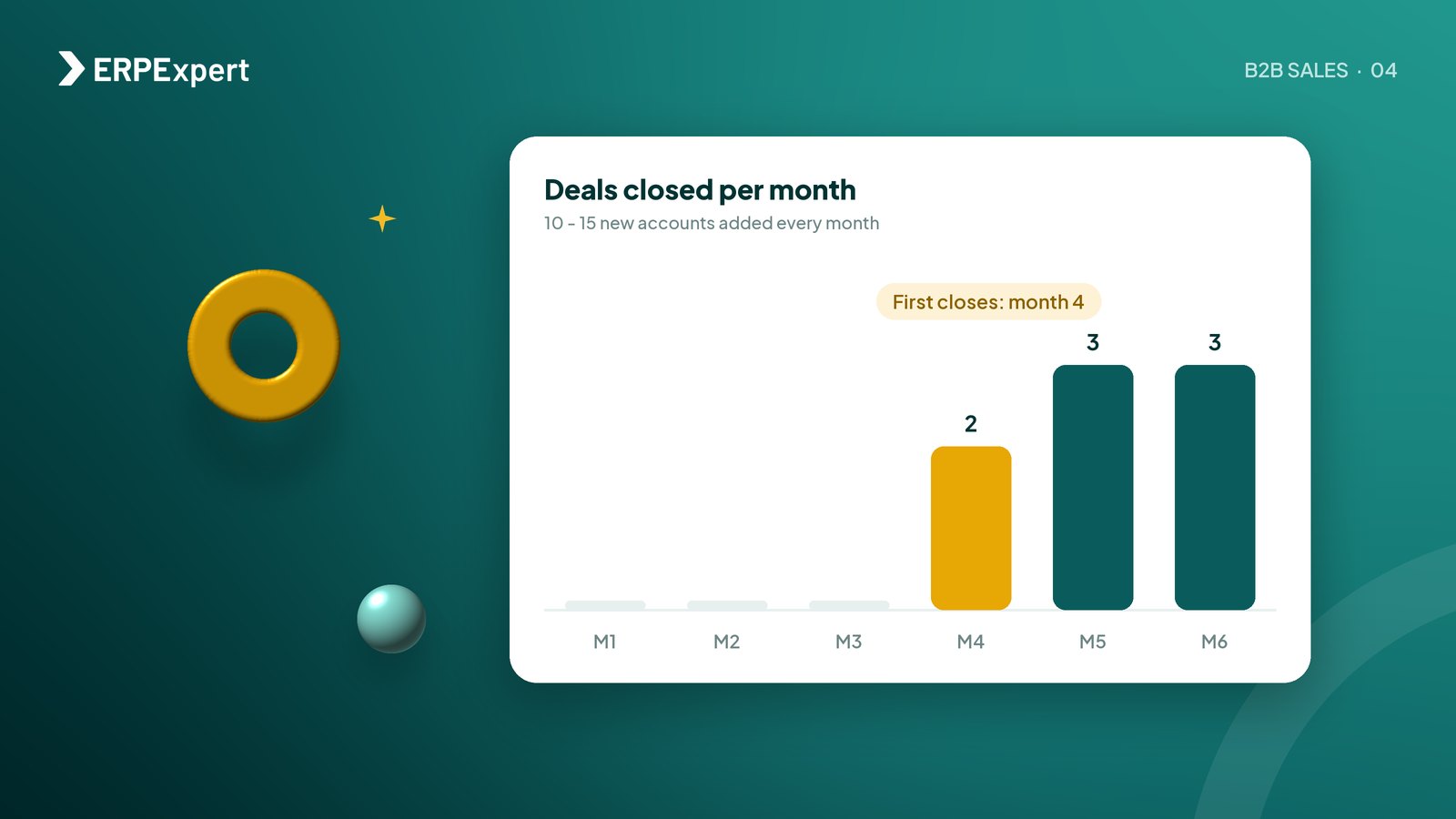
Three to four months. In my experience, that is how long an ERP deal you start working this month takes to close, and it will not close sooner.
That single number explains why so many new salespeople quit early. Someone works hard through month one and month two, signs nothing, and concludes that the method is wrong or that they are not cut out for the job. In reality their first deals simply have not come due.
This piece covers the final part of the training meeting behind this series (in Arabic): how the work builds on itself, and why a network is the most valuable thing a salesperson owns.
How the work compounds
Picture a rep who adds ten to fifteen companies to their list every month, as described in the B2B target account list.
In month one they are working a single batch. In month two, two batches. By month four they are working four, and the oldest has reached negotiation.
From then on, each month one batch arrives at signature while a fresh one joins the list. The rep who spent months with nothing to show finds themselves closing two or three deals a month, at a comfortable pace.
I put it to our new colleague during the training in terms of his own first week. Day one had been very hard; by days three and four the work felt easy. The first months in sales follow the same curve, stretched over a longer scale.
Which is why nobody should judge a new ERP salesperson before month four or five. Any verdict before then is measuring activity. The results have not had time to exist.
“We’ve just bought a system” is not the end of the call
The reply a salesperson hears most often is: “Thanks, we’ve just bought a system. We’ll call you if we need anything.” The instinct is to hang up and dial the next number.
Stay on the line instead, and get to know the person. Their name, their role, what they bought and why.
That person might leave in a year for another company that needs a system. Their current project might stall, and they might go looking for someone to rescue it. Either way, the name they remember will belong to whoever treated them with respect when there was no deal on the table.
Over time, the market comes to know such a rep as “the ERP person”: the one who gets called whenever a company they know needs a system.
What to record about every contact
An unrecorded network gets forgotten. In a year you will not remember the name of the finance director who told you they had just bought a system. So for each person we speak to, we log four things in the CRM:
- Name, role and company, with a link to their LinkedIn profile.
- What they said about their situation: the current system, when they bought it, and who implemented it.
- A follow-up date, six months out for instance, when it will be clear whether the project succeeded or stalled.
- Any change of job, because a move to a new company is an opening for a new conversation.
An example from the day we filmed
While we were recording the training, I took a call from someone who used to work at a company we had implemented a system for. He had moved to another company and was calling to ask us to implement the system there too. Today he and I are discussing a partnership.
That relationship was built over four or five years, through actions before words: a project delivered as promised, and problems solved when they appeared. Had we treated him as a client whose relationship with us ended when the cheque cleared, none of it would have happened.
This is the long game in systems sales. The second deal with the same person is easier than the first, and the third sometimes arrives without being asked for.
The label that sticks
I have never written anywhere that we specialise in Odoo. The market attached that label to us anyway, because most of the people who contact us do so about Odoo or ERP. People know you by the thing they keep seeing you do.
The same holds for a salesperson. Walk in as a rep with a briefcase and a brochure, and the client will remember you as the person who carries orders to the manager. Walk in as someone who understands how the business runs, and a year later the client will call the company and ask for you by name. How that impression starts with your very first sentence on the phone is covered in the B2B cold call.
Your salary follows your network
I told our colleague during the training that his salary was his own responsibility, and gave him a simple sum. Call his current salary X. Over three years he has two routes.
Growth through seniority. Around ten percent a year, because he now knows the product and the company. After three years he is at roughly 1.3X. Someone on a thousand ends up on thirteen hundred.
Growth through what he has built. A network, clients who ask for him by name, targets he hits month after month. That salesperson reaches 4X or 5X, because the company knows other firms would pay him six, seven or ten thousand if it does not.
The gap between the two has nothing to do with call volume. A rep who buys lists of numbers and works through them one by one may well hit target, and still be standing in the same place three or four years later. A rep who builds a relationship with everyone they speak to, including the people who said no, is building an asset that goes with them to any company they join.
About the author
Ahmed Hassan Algammal
ERP implementation consultant. More than 60 deliveries across the UAE, Saudi Arabia and Egypt in manufacturing, contracting and distribution.
Book a call →